
2018-09-03 09:31:00 Mon ET
technology antitrust competition bilateral trade free trade fair trade trade agreement trade surplus trade deficit multilateralism neoliberalism world trade organization regulation public utility current account compliance

Amazon follows Apple to become the second American public corporation to hit $1 trillion stock market valuation. Amazon's founder and chairman Jeff Bezos is now worth about as much as the total net worth of both Bill Gates and Warren Buffett.
Amazon now captures about half of every ecommerce dollar in America. With more than 550,000 employees and $178 billion in annual revenue, Amazon sells almost everything from cloud-computing space to bread and butter.
Amazon sells a great deal of excitement to investors, customers, and media firms. For starters, Amazon excites readers with a new way to shop for books online and then a new way to read Kindle Fire e-books. Amazon excites content creators to curate on Kindle Direct Publisher. Amazon excites cloud users and hackers with a new way to power the Internet via Amazon Web Services. Amazon also excites its premium members with a new way to experience fast delivery via Amazon Prime. Amazon excites many home owners with a new way to interact with an artificially intelligent outpost Alexa.
Bezos focuses on long-term customer-centrism with one pivotal question: What is not going to change in the next decade?
Amazon continues to offer low-price products and services online with fast delivery and vast selection.
If any of our AYA Analytica financial health memos (FHM), blog posts, ebooks, newsletters, and notifications etc, or any other form of online content curation, involves potential copyright concerns, please feel free to contact us at service@ayafintech.network so that we can remove relevant content in response to any such request within a reasonable time frame.
2019-03-19 12:35:00 Tuesday ET

U.S. tech titans increasingly hire PhD economists to help solve business problems. These key tech titans include Facebook, Amazon, Microsoft, Google, Apple,
2020-04-17 07:23:00 Friday ET

Clayton Christensen defines and delves into the core dilemma of corporate innovation with sustainable and disruptive advances. Clayton Christensen (2000)
2019-05-03 11:29:00 Friday ET

Key tech unicorns blitzscale business niches for better scale economies from Uber and Lyft to Pinterest, Slack, and Zoom. LinkedIn cofounder and serial entr
2025-07-05 11:23:00 Saturday ET

Former New York Times science author and Harvard psychologist Daniel Goleman explains why working with emotional intelligence helps hone our social skills f
2018-08-05 12:34:00 Sunday ET

JPMorgan Chase CEO Jamie Dimon sees great potential for 10-year government bond yields to rise to 5% in contrast to the current 3% 10-year Treasury bond yie
2020-05-28 15:37:00 Thursday ET
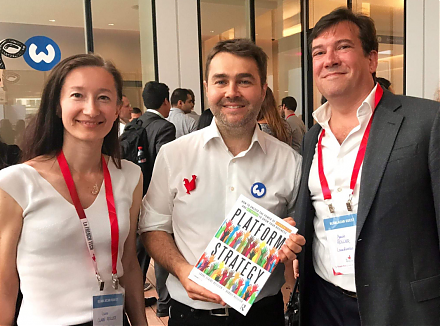
Platform enterprises leverage network effects, scale economies, and information cascades to boost exponential business growth. Laure Reillier and Benoit