Maravai LifeSciences Holdings Inc. Class A Common Stock (NASDAQ:MRVI)

Real-time price: | Most recent change:0.00%

Maravai LifeSciences Holdings Inc. is a life sciences company providing products for the development of drug therapies, diagnostics, novel vaccines and support research on human diseases. The company offer products and services in the fields of nucleic acid synthesis, bioprocess impurity detection and analysis, protein labeling and detection to biopharmaceutical, vaccine, diagnostics and cell and gene therapy companies. Maravai LifeSciences Holdings Inc. is based in SAN DIEGO, Calif....

+See More


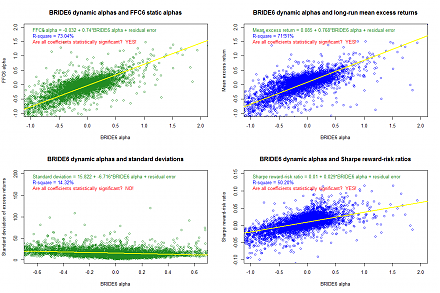
Here we provide our AYA proprietary alpha stock signals for all premium members on our AYA fintech network platform. Specifically, a high Fama-French multi-factor dynamic conditional alpha suggests that the stock is likely to consistently outperform the broader stock market benchmarks such as S&P 500, Dow Jones, Nasdaq, Russell 3000, MSCI USA, and MSCI World etc. Since March 2023, our proprietary alpha stock signals retain U.S. Patent and Trademark Office (USPTO) fintech patent protection, approval, and accreditation for 20 years. Our homepage and blog articles provide more details on this proprietary alpha stock market investment model with robust long-term historical backtest evidence.

Sharpe-Lintner-Black CAPM alpha (Premium Members Only) Fama-French (1993) 3-factor alpha (Premium Members Only) Fama-French-Carhart 4-factor alpha (Premium Members Only) Fama-French (2015) 5-factor alpha (Premium Members Only) Fama-French-Carhart 6-factor alpha (Premium Members Only) Dynamic conditional 6-factor alpha (Premium Members Only) Last update: Saturday 29 November 2025

Blog+More

U.S. bank oligarchy has become bigger and more resistant to public regulation after the global financial crisis.

Laura Hermes

2020-02-19 14:35:00 Wednesday ET

U.S. bank oligarchy has become bigger and more resistant to public regulation after the global financial crisis.

The U.S. bank oligarchy has become bigger, more profitable, and more resistant to public regulation after the global financial crisis. Simon Johnson and

+See More

Lyft seeks to go public with a dual-class stock ownership structure that allows the co-founders to retain significant influence.

Amy Hamilton

2019-03-11 10:32:00 Monday ET

Lyft seeks to go public with a dual-class stock ownership structure that allows the co-founders to retain significant influence.

Lyft seeks to go public with a dual-class stock ownership structure that allows the co-founders to retain significant influence over the rideshare tech unic

+See More

The Economist Intelligence Unit (EIU) continues to track major business risks in light of volatile stock markets.

Fiona Sydney

2019-01-11 10:33:00 Friday ET

The Economist Intelligence Unit (EIU) continues to track major business risks in light of volatile stock markets.

The Economist Intelligence Unit (EIU) continues to track major business risks in light of volatile stock markets, elections, and geopolitics. EIU monitors g

+See More

The Economist interviews President Trump and spots the keyword *reciprocity* from trade to taxation.

Amy Hamilton

2017-07-01 08:40:00 Saturday ET

The Economist interviews President Trump and spots the keyword *reciprocity* from trade to taxation.

The Economist interviews President Donald Trump and spots the keyword *reciprocity* in many aspects of Trumponomics from trade and taxation to infrastructur

+See More

The unique controversial management style of Steve Jobs helps translate his business acumen into smart product development.

Dan Rochefort

2020-03-26 10:31:00 Thursday ET

The unique controversial management style of Steve Jobs helps translate his business acumen into smart product development.

The unique controversial management style of Steve Jobs helps translate his business acumen into smart product development. Jay Elliot (2012) Leading

+See More

David Colander and Craig Freedman argue that economics went wrong when there was no neoclassical firewall between economic theories and policy reforms.

Becky Berkman

2023-11-28 11:35:00 Tuesday ET

David Colander and Craig Freedman argue that economics went wrong when there was no neoclassical firewall between economic theories and policy reforms.

David Colander and Craig Freedman argue that economics went wrong when there was no neoclassical firewall between economic theories and policy reforms. D

+See More