
Atlas Financial Holdings, Inc., through its subsidiaries, engages in underwriting commercial automobile insurance policies in the United States. The company's automobile insurance products provide insurance coverage in three primary areas, including liability, accident benefits, and physical damage. It focuses on the light commercial automobile sector, including taxi cabs, non-emergency para-transit, limousine, livery, and business autos. The company distributes its insurance products through a network of retail independent agents. Atlas Financial Holdings, Inc. is headquartered in Schaumburg, Illinois....
+See MoreSharpe-Lintner-Black CAPM alpha (Premium Members Only) Fama-French (1993) 3-factor alpha (Premium Members Only) Fama-French-Carhart 4-factor alpha (Premium Members Only) Fama-French (2015) 5-factor alpha (Premium Members Only) Fama-French-Carhart 6-factor alpha (Premium Members Only) Dynamic conditional 6-factor alpha (Premium Members Only) Last update: Saturday 17 October 2026
2019-10-01 11:33:00 Tuesday ET

The Trump administration postpones increasing 25% to 30% tariffs on $250 billion Chinese imports after China extends an olive branch to de-escalate Sino-Ame
2018-10-17 12:33:00 Wednesday ET

The Trump administration blames China for egregious currency misalignment, but this criticism cannot confirm *currency manipulation* on the part of the Chin
2018-02-01 07:38:00 Thursday ET

U.S. senators urge the Trump administration with a bipartisan proposal to prevent the International Monetary Fund (IMF) from bailing out several countries t
2022-04-05 17:39:00 Tuesday ET

Corporate diversification theory and evidence A recent strand of corporate diversification literature spans at least three generations. The first generat
2018-06-04 08:38:00 Monday ET

Microsoft acquires GitHub, a software development platform that has been widely shared-and-used by more than 28 million programmers worldwide. GitHub's
2019-03-27 11:28:00 Wednesday ET
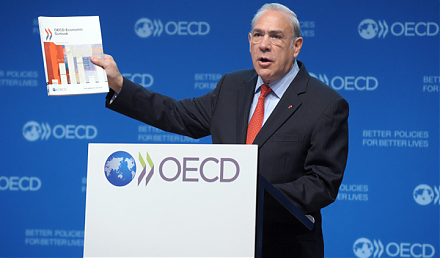
OECD cuts the global economic growth forecast from 3.5% to 3.3% for the current fiscal year 2019-2020. The global economy suffers from economic protraction
 Reports
 Metrics
 Events
 AI Stock Synopses