BLDRS Europe 100 ADR Index Fund (NASDAQ:ADRU)

Real-time price: | Most recent change:0.00%

BLDRS Europe 100 ADR Index Fund (the Fund) is a unit investment trust designed to provide investment results that correspond generally to the price and yield performance of the publicly traded depositary receipts comprising The Bank of New York Europe 100 ADR Index. As of September 30, 2006, The BNY Europe 100 ADR Index included 100 component depositary receipts representing the securities issued by 100 of the most actively traded companies from the European market having a free-float market capitalization ranging from $5 billion to over $260 billion. ...

+See More


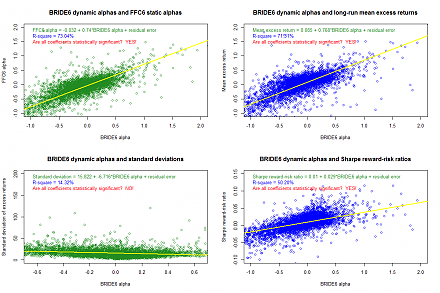
Here we provide our AYA proprietary alpha stock signals for all premium members on our AYA fintech network platform. Specifically, a high Fama-French multi-factor dynamic conditional alpha suggests that the stock is likely to consistently outperform the broader stock market benchmarks such as S&P 500, Dow Jones, Nasdaq, Russell 3000, MSCI USA, and MSCI World etc. Since March 2023, our proprietary alpha stock signals retain U.S. Patent and Trademark Office (USPTO) fintech patent protection, approval, and accreditation for 20 years. Our homepage and blog articles provide more details on this proprietary alpha stock market investment model with robust long-term historical backtest evidence.

Sharpe-Lintner-Black CAPM alpha (Premium Members Only) Fama-French (1993) 3-factor alpha (Premium Members Only) Fama-French-Carhart 4-factor alpha (Premium Members Only) Fama-French (2015) 5-factor alpha (Premium Members Only) Fama-French-Carhart 6-factor alpha (Premium Members Only) Dynamic conditional 6-factor alpha (Premium Members Only) Last update: Saturday 11 April 2026

Blog+More

The U.S. federal government debt has risen from less than 40% of total GDP about a decade ago to 78% as of May 2018.

John Fourier

2018-06-01 07:30:00 Friday ET

The U.S. federal government debt has risen from less than 40% of total GDP about a decade ago to 78% as of May 2018.

The U.S. federal government debt has risen from less than 40% of total GDP about a decade ago to 78% as of May 2018. The Congressional Budget Office predict

+See More

Facebook, Apple, Amazon, Netflix, and Google (FAANG) have been the motor of the S&P 500 stock market index.

Dan Rochefort

2018-06-11 07:44:00 Monday ET

Facebook, Apple, Amazon, Netflix, and Google (FAANG) have been the motor of the S&P 500 stock market index.

Facebook, Apple, Amazon, Netflix, and Google (FAANG) have been the motor of the S&P 500 stock market index. Several economic media commentators contend

+See More

Incoming New York Fed President John Williams suggests that it is about time to end forward guidance.

Becky Berkman

2018-05-13 08:33:00 Sunday ET

Incoming New York Fed President John Williams suggests that it is about time to end forward guidance.

Incoming New York Fed President John Williams suggests that it is about time to end forward guidance in order to stop holding the financial market's han

+See More

Sprint and T-Mobile propose a major merger in order to better compete with AT&T and Verizon.

Joseph Corr

2018-05-03 07:34:00 Thursday ET

Sprint and T-Mobile propose a major merger in order to better compete with AT&T and Verizon.

Sprint and T-Mobile propose a major merger in order to better compete with AT&T and Verizon. This mega merger is worth $26.5 billion and involves an all

+See More

IMF chief economist Gita Gopinath predicts no global recession with key downside risks at this delicate moment.

Charlene Vos

2019-04-29 08:35:00 Monday ET

IMF chief economist Gita Gopinath predicts no global recession with key downside risks at this delicate moment.

IMF chief economist Gita Gopinath predicts no global recession with key downside risks at this delicate moment. First, trade tensions remain one of the key

+See More

The financial crisis of 2008-2009 affects many millennials as they bear the primary costs of college tuition, residential demand, health care, and childcare.

Peter Prince

2019-06-23 08:30:00 Sunday ET

The financial crisis of 2008-2009 affects many millennials as they bear the primary costs of college tuition, residential demand, health care, and childcare.

The financial crisis of 2008-2009 affects many millennials as they bear the primary costs of college tuition, residential demand, health care, and childcare

+See More