
Intel Corporation, one of the world's largest semiconductor company and primary supplier of microprocessors and chipsets, is gradually moving into data-centric businesses such as AI and autonomous driving. Intel is a dominant player for microprocessors in both consumer and enterprise markets. Data Center Group, Internet of Things Group, Mobileye, Non-Volatile memory solutions group and Programmable solutions Group and All Other business units form the crux of Intel's data-centric business model. DCG segment deals with servers, workstations and other products for cloud, enterprise, and communication infrastructure market. IOTG offers high-performance compute solutions and embedded applications. PSG segment offers programmable semiconductors, primarily FPGAs and structured ASICs. Mobileye is engaged in developing computer vision and machine learning-based sensing, data analysis, localization, mapping, and driving policy technology for ADAS and autonomous driving....
+See More2018-10-30 10:41:00 Tuesday ET

Personal finance author Ramit Sethi suggests that it is important to invest in long-term gains instead of paying attention to daily dips and trends. It
2018-12-03 10:40:00 Monday ET

Bank of England publishes its latest insights into the economic impact of Brexit on British real productivity, capital investment, and labor supply as of 20
2022-02-02 10:33:00 Wednesday ET
Our proprietary alpha investment model outperforms most stock market indices from 2017 to 2022. As of early-January 2023, the U.S. Patent and Trademark O
2017-04-25 06:35:00 Tuesday ET
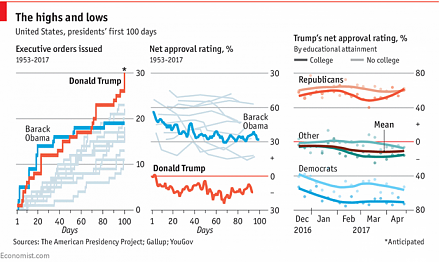
This nice and clear infographic visualization helps us better decipher the main memes and themes of President Donald Trump's first 100 days in office.
2017-06-15 07:32:00 Thursday ET

President Donald Trump has discussed with the CEOs of large multinational corporations such as Apple, Microsoft, Google, and Amazon. This discussion include
2019-02-11 09:37:00 Monday ET

Corporate America uses Trump tax cuts and offshore cash stockpiles primarily to fund share repurchases for better stock market valuation. Share repurchases