
2018-10-03 11:37:00 Wed ET
federal reserve monetary policy treasury dollar employment inflation interest rate exchange rate macrofinance recession systemic risk economic growth central bank fomc greenback forward guidance euro capital global financial cycle credit cycle yield curve

Fed Chair Jerome Powell sees a remarkably positive outlook for the U.S. economy right after the recent interest rate hike as of September 2018. He humbly suggests that this positive outlook may be too good to be true. The U.S. economy operates near full employment with low inflation. The current U.S. unemployment rate is at the historically low level of 3.9%, and the inflation rate hovers around the Federal Reserve's medium-term target of 2%. These top-line statistics may not present an accurate picture of overall economic conditions, but a wide range of economic data on jobs and prices supports a positive view.
This combination not only serves well the Federal Reserve's dual mandate of both maximum employment and price stability, but also raises the reasonable question of whether real GDP economic growth is sustainable in the next few years. In light of high household consumption, capital investment, and credit supply expansion, the Federal Reserve expects real output growth to approach 3%+ until early-2020.
Low inflation and low unemployment arise as a rare combination in modern U.S. economic history. Whether this rare combination can sustain in the medium term remains an open controversy. With this ambivalence, U.S. economists, consumers, producers, and financial intermediaries remain in extraordinary times.
If any of our AYA Analytica financial health memos (FHM), blog posts, ebooks, newsletters, and notifications etc, or any other form of online content curation, involves potential copyright concerns, please feel free to contact us at service@ayafintech.network so that we can remove relevant content in response to any such request within a reasonable time frame.
2019-04-01 08:28:00 Monday ET

OraSure and its subsidiary DNA Genotek specialize in the lean production of home DNA spit tubes. OraSure extracts core genetic information from microbiome s
2019-01-10 17:31:00 Thursday ET

The recent Bristol-Myers Squibb acquisition of American Celgene is the $90 billion biggest biotech deal in history. The resultant biopharma goliath would be
2019-07-13 07:17:00 Saturday ET

Japanese prime minister Shinzo Abe outlines the main economic priorities for the G20 summit in Osaka, Japan. First, Asian countries need to forge the key Re
2025-09-28 10:10:51 Sunday ET

Stock Synopsis: With a new Python program, we use, adapt, apply, and leverage each of the mainstream Gemini Gen AI models to conduct this comprehensive fund
2019-09-15 14:35:00 Sunday ET
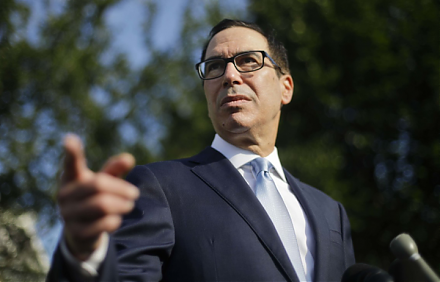
U.S. Treasury officially designates China a key currency manipulator in the broader context of Sino-American trade dispute resolution. The U.S. Treasury cla
2018-11-27 10:37:00 Tuesday ET

Warren Buffett offloads a few stocks from the Berkshire Hathaway portfolio in mid-November 2018. The latest S.E.C. report shows that the Oracle of Omaha sol