
2018-01-29 07:38:00 Mon ET
technology social safety nets education infrastructure health insurance health care medical care medication vaccine social security pension deposit insurance
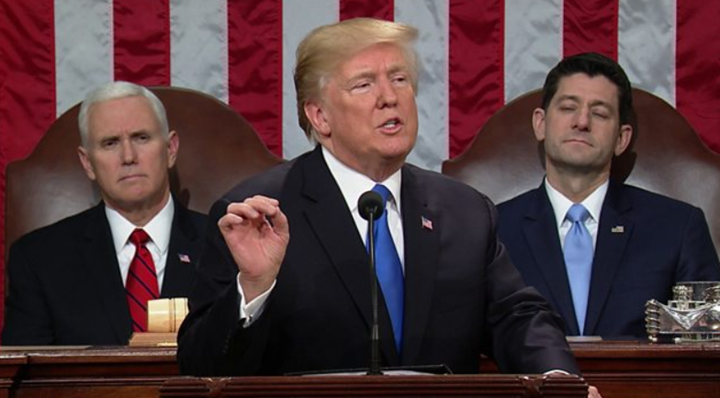
President Donald Trump delivers his first state-of-the-union address. Several key highlights touch on economic issues from fiscal stimulus and trade protectionism to infrastructure, immigration, and social security. The hefty Trump tax cuts provide tremendous relief for the middle-class Americans and small businesses. About 3 million American workers receive tax incentives primarily due to this legislative win for the Trump administration and Republican-driven Congress.
When the U.S. Trade Act Section 301 investigation concludes in due course, the Trump administration expects to escalate tariffs, quotas, and even embargoes on Chinese imports. These tariffs and other trade barriers effectively penalize China for perennial patent, trademark, and copyright infringement and other intellectual property theft. This trade protectionism helps eradicate hefty U.S. trade deficits to the detriment of China and western allies such as Canada, Europe, and Mexico.
Trump now urges Congress to pass fresh legislation to replenish $1.5 trillion U.S. modern infrastructure with new roads, bridges, highways, railways, and waterways. Also, the Trump administration designs new immigration policies with better border control to circumvent drugs, gangs, and other criminal activities that plaque many U.S. immigrant communities.
Finally, President Trump now considers foreign investment restrictions in defense of national security from LTE broadband technology to 5G telecommunication. All these economic reforms help ensure sustainable economic prosperity in America.
If any of our AYA Analytica financial health memos (FHM), blog posts, ebooks, newsletters, and notifications etc, or any other form of online content curation, involves potential copyright concerns, please feel free to contact us at service@ayafintech.network so that we can remove relevant content in response to any such request within a reasonable time frame.
2019-05-01 09:27:00 Wednesday ET
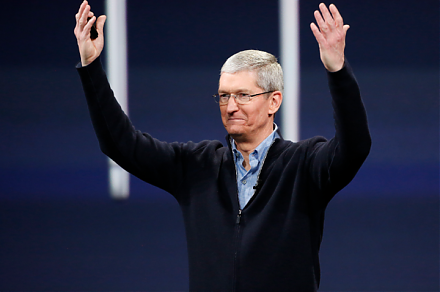
Apple settles its 2-year intellectual property lawsuit with Qualcomm by agreeing to a multi-year patent license with royalty payments to the microchip maker
2024-02-04 08:28:00 Sunday ET
Our proprietary alpha investment model outperforms most stock market indexes from 2017 to 2024. Our proprietary alpha investment model outperforms the ma
2018-12-11 10:34:06 Tuesday ET

Several eminent American China-specialists champion the key notion of *strategic engagement* with the Xi administration. From the Hoover Institution at Stan
2019-10-27 17:37:00 Sunday ET
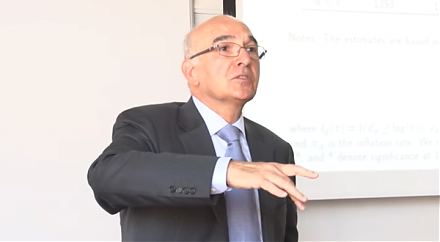
International climate change can cause an adverse impact on long-term real GDP economic growth. USC climate change economist Hashem Pesaran and his co-autho
2019-08-09 18:35:00 Friday ET
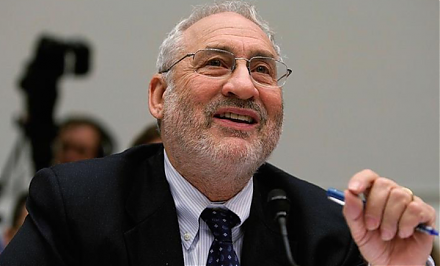
Nobel Laureate Joseph Stiglitz maintains that globalization only works for a few elite groups; whereas, the government should now reassert itself in terms o
2025-10-05 17:31:00 Sunday ET

Stock Synopsis: With a new Python program, we use, adapt, apply, and leverage each of the mainstream Gemini Gen AI models to conduct this comprehensive fund