
2017-08-19 14:43:00 Sat ET
technology social safety nets education infrastructure health insurance health care medical care medication vaccine social security pension deposit insurance
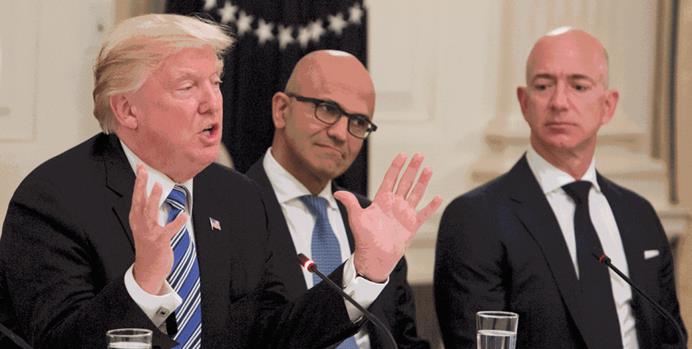
In a recent tweet, President Donald Trump criticizes Amazon over taxes and jobs. Without providing specific evidence, Trump accuses of the e-commerce retailer of hurting U.S. cities and states with job losses. Amazon's stock price declines quite a bit after this tweet. In his critique, Trump has targeted Amazon whose CEO Jeff Bezos owns the Washington Post, one of several major media outlets that have been swept up in the president's relentless fight with the press.
Now stock analysts and market observers wait for Treasury Secretary Steve Mnuchin to deliver on Trump's promise of a comprehensive fiscal overhaul with a particular emphasis on lower income taxation and special tax holiday for offshore corporate cash repatriation.
In addition to its recent acquisition of Whole Foods, Amazon can draw down its offshore cash reservoir throughout the prospective tax holiday to continue the current Trump stock market rally. The same logic also applies to several other multinational corporations such as Apple, Google, Microsoft, Facebook, Exxon Mobil, Johnson & Johnson, and so forth. Although the stock market valuation seems high with a long-term P/E ratio of 25x to 27x, the Trump stock market rally may move in tandem with the current interest rate hike as new economic data suggest robust labor market recovery and capital momentum.
If any of our AYA Analytica financial health memos (FHM), blog posts, ebooks, newsletters, and notifications etc, or any other form of online content curation, involves potential copyright concerns, please feel free to contact us at service@ayafintech.network so that we can remove relevant content in response to any such request within a reasonable time frame.
2019-09-09 20:38:00 Monday ET
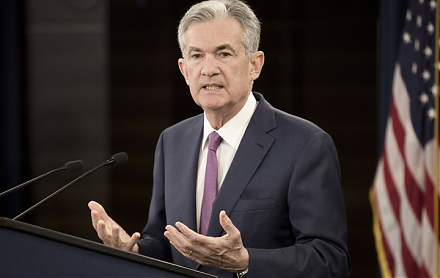
Harvard macrofinance professor Robert Barro sees no good reasons for the recent sudden reversal of U.S. monetary policy normalization. As Federal Reserve Ch
2023-10-07 10:24:00 Saturday ET

Thomas Philippon draws attention to greater antitrust scrutiny in light of the rise of market power and its economic ripple effects. Thomas Philippon (20
2023-05-21 12:26:00 Sunday ET

Amy Chua and Jed Rubenfeld suggest that relatively successful ethnic groups exhibit common cultural traits in America. Amy Chua and Jed Rubenfeld (2015)
2018-03-09 08:33:00 Friday ET
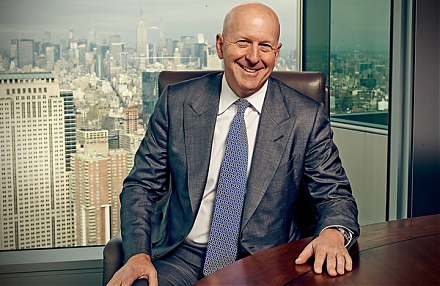
David Solomon succeeds Lloyd Blankfein as the new CEO of Goldman Sachs. Unlike his predecessors Lloyd Blankfein and Gary Cohn, Solomon has been an investmen
2019-07-13 07:17:00 Saturday ET
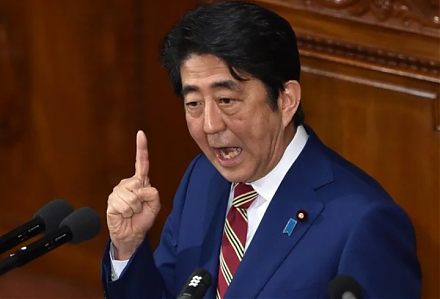
Japanese prime minister Shinzo Abe outlines the main economic priorities for the G20 summit in Osaka, Japan. First, Asian countries need to forge the key Re
2020-07-19 09:25:00 Sunday ET

Senior business leaders can learn much from the lean production system with iterative continuous improvements at Toyota. Takehiko Harada (2015)