
2018-06-11 07:44:00 Mon ET
stock market gold oil stock return s&p 500 asset market stabilization asset price fluctuations stocks bonds currencies commodities funds term spreads credit spreads fair value spreads asset investments
Facebook, Apple, Amazon, Netflix, and Google (FAANG) have been the motor of the S&P 500 stock market index. Several economic media commentators contend that most U.S. stock market returns emerge from a small fraction of stocks. This concentration tilts toward network platform orchestrators that specialize in mobile communication, ecommerce, music, video, online search, and advertisement etc. These platform orchestrators attract many early technology adopters and venture capitalists. The former pour money into the mass purchases of mobile devices and online software services, and the latter inject capital into the tech titans at an early stage.
Apple and Amazon are both the first U.S. heavyweight tech giants that pass the landmark $1 trillion stock market valuation. Sino-American trade war worries now constrain S&P 500 year-to-date gains to 3.5% as of June 2018. In comparison, the FAANG group reaps hefty double-digits and so show business immunization to the Trump tariffs. The tech titans make productive uses of their intellectual properties such as patents, trademarks, and copyrights. This mega moat protection secures competitive advantages for their platform infrastructure.
As a result, these tech firms can better extract bottom-line rewards from the latest technological gadgets and services in mobile communication, ecommerce, online search, music, video, and advertisement etc.
If any of our AYA Analytica financial health memos (FHM), blog posts, ebooks, newsletters, and notifications etc, or any other form of online content curation, involves potential copyright concerns, please feel free to contact us at service@ayafintech.network so that we can remove relevant content in response to any such request within a reasonable time frame.
2023-01-03 09:34:00 Tuesday ET
USPTO fintech patent protection and accreditation As of early-January 2023, the U.S. Patent and Trademark Office (USPTO) has approved
2017-08-01 09:40:00 Tuesday ET
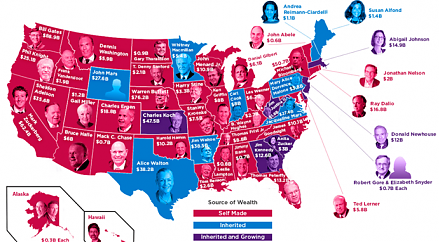
In American states, all of the Top 4 richest people are self-made billionaires: Bill Gates in Washington, Warren Buffett in Nebraska, Michael Bloomberg in N
2020-10-13 08:27:00 Tuesday ET

Agile lean enterprises strive to design radical business models to remain competitive in the face of nimble startups and megatrends. Carsten Linz, Gunter
2027-11-22 08:26:00 Monday ET

Our AYA fun podcasts deep-dive into the current global trends, topics, and issues in macro finance, political economy, public policy, strategic management,
2023-01-11 09:26:00 Wednesday ET
Addendum on USPTO fintech patent protection and accreditation As of early-January 2023, the U.S. Patent and Trademark Office (USPTO) has approved our U.S
2019-01-17 10:41:00 Thursday ET

Sino-American trade talks make positive progress over 3 consecutive days as S&P 500 and global stock market indices post 3-day win streaks. Asian and Eu