Equity Distribution Acquisition Corp. Class A Common Stock (NYSE:EQD)

Real-time price: | Most recent change:0.00%

Equity Distribution Acquisition Corp. is a blank check company. It formed for the purpose of merger, capital stock exchange, asset acquisition, stock purchase, reorganization or similar business combination with one or more businesses. Equity Distribution Acquisition Corp. is based in Chicago, Illinois....

+See More


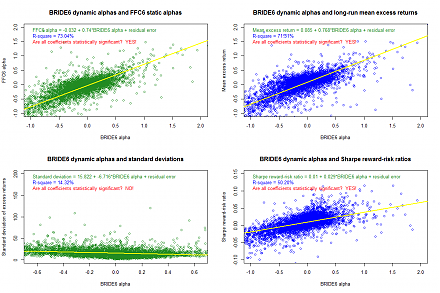
Here we provide our AYA proprietary alpha stock signals for all premium members on our AYA fintech network platform. Specifically, a high Fama-French multi-factor dynamic conditional alpha suggests that the stock is likely to consistently outperform the broader stock market benchmarks such as S&P 500, Dow Jones, Nasdaq, Russell 3000, MSCI USA, and MSCI World etc. Since March 2023, our proprietary alpha stock signals retain U.S. Patent and Trademark Office (USPTO) fintech patent protection, approval, and accreditation for 20 years. Our homepage and blog articles provide more details on this proprietary alpha stock market investment model with robust long-term historical backtest evidence.

Sharpe-Lintner-Black CAPM alpha (Premium Members Only) Fama-French (1993) 3-factor alpha (Premium Members Only) Fama-French-Carhart 4-factor alpha (Premium Members Only) Fama-French (2015) 5-factor alpha (Premium Members Only) Fama-French-Carhart 6-factor alpha (Premium Members Only) Dynamic conditional 6-factor alpha (Premium Members Only) Last update: Saturday 18 April 2026

Blog+More

Federal Reserve's interest rate hike may lead to an economic recession as credit supply growth ebbs and flows through the business cycle.

Monica McNeil

2018-06-14 10:35:00 Thursday ET

Federal Reserve's interest rate hike may lead to an economic recession as credit supply growth ebbs and flows through the business cycle.

The Federal Reserve's current interest rate hike may lead to the next economic recession as credit supply growth ebbs and flows through the business cyc

+See More

Facebook, Google, and Twitter attend a U.S. House testimony on whether these tech titans filter web content for political reasons.

Amy Hamilton

2018-07-15 11:35:00 Sunday ET

Facebook, Google, and Twitter attend a U.S. House testimony on whether these tech titans filter web content for political reasons.

Facebook, Google, and Twitter attend a U.S. House testimony on whether these social media titans filter web content for political reasons. These network pla

+See More

Trump tariffs begin to bite U.S. corporate profits from Ford and Harley-Davidson to Caterpillar and Walmart etc.

James Campbell

2018-10-25 10:36:00 Thursday ET

Trump tariffs begin to bite U.S. corporate profits from Ford and Harley-Davidson to Caterpillar and Walmart etc.

Trump tariffs begin to bite U.S. corporate profits from Ford and Harley-Davidson to Caterpillar and Walmart etc. U.S. corporate profit growth remains high a

+See More

Apple is now the world's biggest dividend payer with its $13 billion dividend payout.

Dan Rochefort

2017-04-19 17:37:00 Wednesday ET

Apple is now the world's biggest dividend payer with its $13 billion dividend payout.

Apple is now the world's biggest dividend payer with its $13 billion dividend payout and surpasses ExxonMobil's dividend payout record. Despite the

+See More

U.S. yield curve inversion can be a sign but not a root cause of the next economic recession.

Dan Rochefort

2019-09-19 15:30:00 Thursday ET

U.S. yield curve inversion can be a sign but not a root cause of the next economic recession.

U.S. yield curve inversion can be a sign but not a root cause of the next economic recession. Treasury yield curve inversion helps predict each of the U.S.

+See More

David Colander and Craig Freedman argue that economics went wrong when there was no neoclassical firewall between economic theories and policy reforms.

Becky Berkman

2023-11-28 11:35:00 Tuesday ET

David Colander and Craig Freedman argue that economics went wrong when there was no neoclassical firewall between economic theories and policy reforms.

David Colander and Craig Freedman argue that economics went wrong when there was no neoclassical firewall between economic theories and policy reforms. D

+See More