
AAR Corp. provides various products & services to the aviation & defense industries world wide. Its principal customers are The Boeing Co. and Airbus. It has 2 business segments: Aviation Services and Expeditionary Services. The Aviation Services unit provides aftermarket support & services for the commercial aviation, and government & defense markets. It sells & leases various new, overhauled and repaired engine & airframe parts & components, and aircraft to commercial aviation and government/defense customers. It provides inventory management & distribution services, overhaul, repair and engineering services. The Expeditionary Services segment includes airlift & mobility activities. This division provides products and services for the movement of equipment and personnel by the U.S. Department of Defense, foreign governments/ non-governmental organizations. This unit also designs manufactures and installs in-plane cargo loading and handling systems for commercial aircraft, military aircraft and helicopters....
+See More2023-07-07 10:29:00 Friday ET

Louis Kaplow strives to find a delicate balance between efficiency gains and redistributive taxes in the social welfare function. Louis Kaplow (2010)
2018-05-06 07:30:00 Sunday ET

President Trump withdraws America from the Iran nuclear agreement and revives economic sanctions on Iran for better negotiations as western allies Britain,
2018-07-05 13:40:00 Thursday ET

U.S. trading partners such as the European Union, Canada, China, Japan, Mexico, and Russia voice their concern at the World Trade Organization (WTO) in ligh
2019-03-27 11:28:00 Wednesday ET
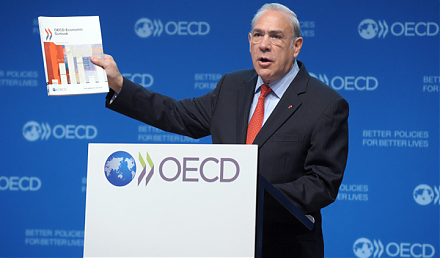
OECD cuts the global economic growth forecast from 3.5% to 3.3% for the current fiscal year 2019-2020. The global economy suffers from economic protraction
2017-12-19 09:39:00 Tuesday ET

From Oprah Winfrey to Bill Gates, this infographic visualization summarizes the key habits and investment styles of highly successful entrepreneurs:
2023-11-21 11:32:00 Tuesday ET

Nobel Laureate Paul Milgrom explains the U.S. incentive auction of wireless spectrum allocation from TV broadcasters to telecoms. Paul Milgrom (2019)